
A Journey of Self-Discovery
I had a rustic childhood. A no-frills life that was neither encumbered by material excess nor want. A life that many who grew up in the countryside can relate to: the simple joys of winding footpaths through family farms, shrubbery, and clusters of homes, one’s kin and folk always nearby. A mosaic of built and open spaces giving way every so often to picturesque landforms. Growing up with the great outdoors as our playground, we chased butterflies in the fields and searched for beautiful red and black ombulu seeds in the backyard. It was a labour of love building toys with our own hands from clay, cardboard boxes, old rags, paper bags – we seemed to be able to fashion toys, nay, joy out of just about anything. It also seemed that we were on our feet all day, spending all our spare time racing, kicking and throwing ball, skipping and just bounding about endlessly. No matter how urbanite I may seem today, deep down, I hold on to that inner country child, wanting to experience her world again now and then.
Remember that distinctive yearning in the late teenage years to leave the shelter of home and everything familiar behind, to go to a far-off place, live unbridled lives and change the world? How curious that many of us, while on this path, also have a newfound appreciation for the simple joys of the times gone by!
I’ve learned that monotony is the bane of urban living. A break now and then from the noise and bustle of the city is essential. One of the upsides of living in this region is the array of nature getaways available year-round. Our forebears lived in harmony with the land – respecting the integrity of the land in every industry, from Agriculture to the Arts. How refreshing it is to be able to step back in time while visiting some of the most remote and quiet places today, from the savannah grasslands to the coast; some of the highest peaks and outcrops, and my favorite, having had one quite literally in my childhood backyard: scenic waterbodies. I grew up on the shores of the world’s largest tropical lake – Nam Lolwe. We woke up every morning to the beautiful scenery of the lake’s shimmer, which appeared as though a vertical expanse of blue – grey with a light shimmer, depending on the weather, completely sweeping the eastern horizon. The lake permeates just about every aspect of community life: it is a fishing and farming hub; a waterway enabling connectivity with neighbors, even across national borders; a social hub supporting the crafts sector with raw materials such as reeds and sand and a favorite among the youth for swimming.
I recall evenings spent with family enjoying the evening breeze blowing in from the lake, and as children, watching the bright glow of the fishermen’s lanterns light up in the horizon. On a work trip in Entebbe, Uganda, as an adult, I feel just as rooted and connected as if I were back home as I looked out my hotel window at the shimmering waters of Nam Lolwe! Knowing these are the same waters I grew up gazing at from my front door, I feel right at home whilst hundreds of miles away in neighbouring Uganda.
I have encountered many who do not necessarily share my affinity for the rustic. Urbanites from birth whose life stories weave a tale of city-like restlessness and egoism through the years. They are inexplicably at home with the city’s odds and quirks. At 16, I fancied myself a misplaced urbanite, too. As it turns out, this was all fantasy based on surface-level impressions of the city – the apparent glitz and fast life, overlooking the vague complexities of urban living. Living in the city for over a decade now, I have gained clarity on some of its loftiest attributes, and glitz is not one of them. Rather, it is the multi-cultural experiences, economic opportunities across multiple industries and interconnectivity with the rest of the globe. Still, I’d be the first to sign up for an Urbanity 101 class because, for all its lofty ideals and promise, city life falls does usher in lifestyle choices that undermine wellness for both people and the environment.
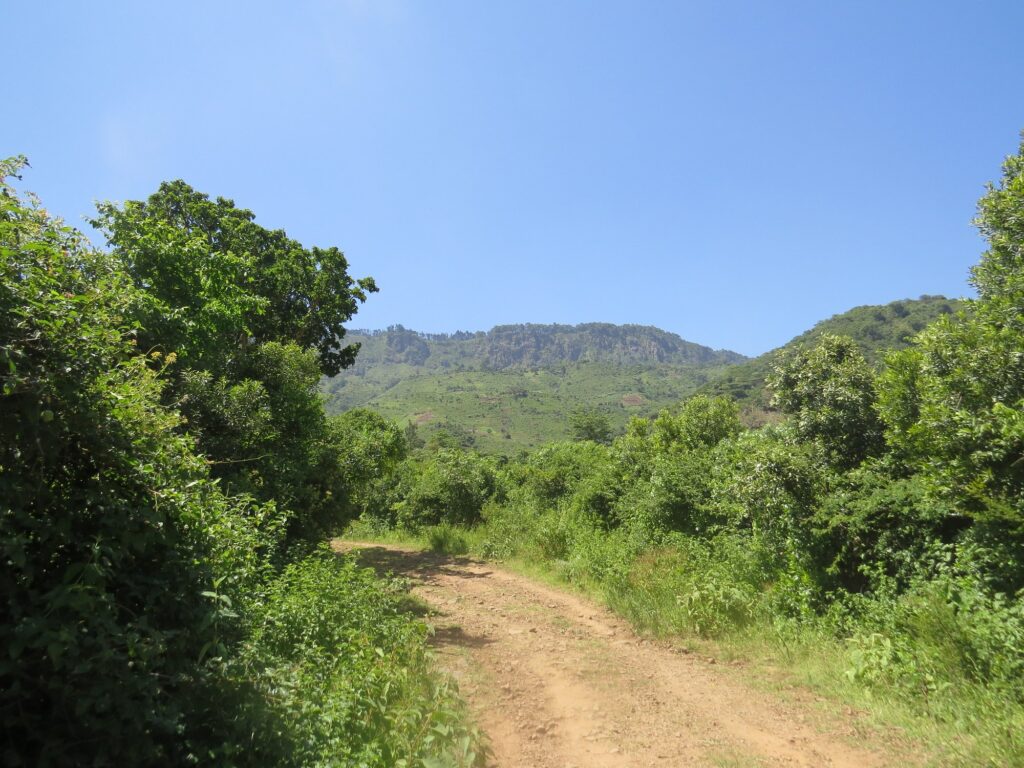
I found myself reminiscing on the good old days a while back as a group of friends and I attempted to hike to Torok Falls in Elgeyo Marakwet County, Kenya. An hour into the hike, a few of us, me included, dropped off, unable to trek to the peak. As we sat trying to catch our breath, now and then, local children as well as adults passed us by going about their daily routine – heading home from the farm, school, visiting friends, tending livestock, children playing about – sauntering up and down the daunting slopes as though it was nothing. Just going about their ordinary, daily routine. I reminisced on the good old days of my life in the countryside.
Even from our halfway up perch, we got amazing views of the falls in the distance, whilst surrounded by such diverse, indigenous vegetation and beauty. I spotted nearly half a dozen plant species I hadn’t seen in years, since my childhood. The amber rays of the setting sun cast a certain glow over the rugged land, creating a scene so beautiful, it was evocative of an artist’s painting. The clean air and quiet felt like instant rejuvenation for my soul. In that moment, I couldn’t be happier being away from the city.
A few weeks later, in a room full of members of the local community, local leaders, the business community, conservationists, school children, government representatives and members of the media, footage from this trip played on screen as part of a broader awareness-raising campaign about this invaluable piece of living heritage, and to inspire action to safeguard it. “National sanctuary status is a natural next step in our efforts to conserve this delicate and invaluable ecosystem; to protect the tens of endangered species endemic to this area,” I said as my brief submission to the Friends of the Environment gathered in the room concluded. Suddenly, it dawned on me that what I had intended as a one-time volunteer experience working on this campaign would become a long-term commitment to using my voice to advance the cause of conservation in my country and across the globe.

Leave a Reply