
Inspiration and Adventures on the Kenyan Coast
I love stories – listening to them, telling them, thinking about them. To be able to inhabit, even if momentarily, the amazing worlds they weave together does not get old. Myths and methali – pithy, Swahili sayings – are my favorites and have been since I was a child.
Growing up seems like a whizz of two distinct memories: trudging alongside mama from the house to the farm and everywhere in between, tugging on her skirts for physical connection and to catch her attention every so often even as she went about her chores; and being a little older and more independent and making the outdoors our playground, bounding about seemingly from sunrise to sunset, often with a little mischief here and there.
Mamas’ skirts were not ordinary: they donned an iconic piece of culture – a kanga or leso. Wrapped around the waist or bosom, the kanga is distinctively colourful, bears bold patterns and its most distinctive feature, pithy sayings that were traditionally coined by the older generation out of their life experiences and lessons. These were deep sayings that commanded more than a passing nod – they drew you in and made you ponder about things, about life. There were profound and even life-changing truths encompassed within these sayings. I remember vividly craning my head to read what was written on every leso that came within my view. I would then conjure up images in my mind of what I had read and what it might mean.
As I grew up, so did my curiosity about the culture that originated the kanga and leso – the Swahili culture. The monsoon winds of the Indian Ocean brought visitors to the East African coast as early as two millennia ago as indicate by such historical records as the 1 century AD Peryplus of the Erythrean Sea. The early visitors traded with the inhabitants of the coast, their intercultural interaction at the Coastal strip bearing a distinct culture, the Swahili culture. The
oldest living Swahili settlement in East Africa, Lamu, boasts over 700 years of continued settlement. To date, Lamu maintains its classical Swahili architecture; her narrow, winding streets and a distinctively serene atmosphere. The serenity has endeared Lamu to holiday makers who escape to the archipelago from all over the world.
When I finally took my first trip as an adult, I headed off to the Kenyan coast.
Kenya’s coastline of the Indian Ocean stretches 585km; varying in character along its length and traversing 4 different counties, that is, Mombasa, Kwale, Lamu and Kilifi. Lamu, the archipelago, is comparatively not as easy to access as the other coastal destinations, and stays on many people’s bucket lists longer.
On my first visit to Malindi, the administrative capital of Kilifi County that boasts a beautiful coastline, one of my top requirements was easy access to both the beach and Malindi town, to make the most of the trip.
Malindi Marine National Reserve is easily one of the richest, most biodiverse locations on Kenya’s coastline. It is a longtime favorite amongst aquatic enthusiasts, and the first marine protected area in Kenya, established in 1968. It was designated a Biosphere Reserve under the Man & Biosphere Reserve programme of UNESCO in 1979.
On arrival, one is immediately taken in by the scenic beauty, evocative of an artist’s painting. A wide-open rock elevation gives way to the beach and provides sweeping views over the ocean stretching out into the horizon, and views of inland Malindi town skyline. We took a moment just to soak in the view, the ocean breeze and the pleasant, warm morning sun. We could not have found a better way to begin to unwind from our rigorous daily grind.
Most mornings, the turquoise water is warm and inviting, the tide is high, and the water pretty calm. It makes for amazing swimming.
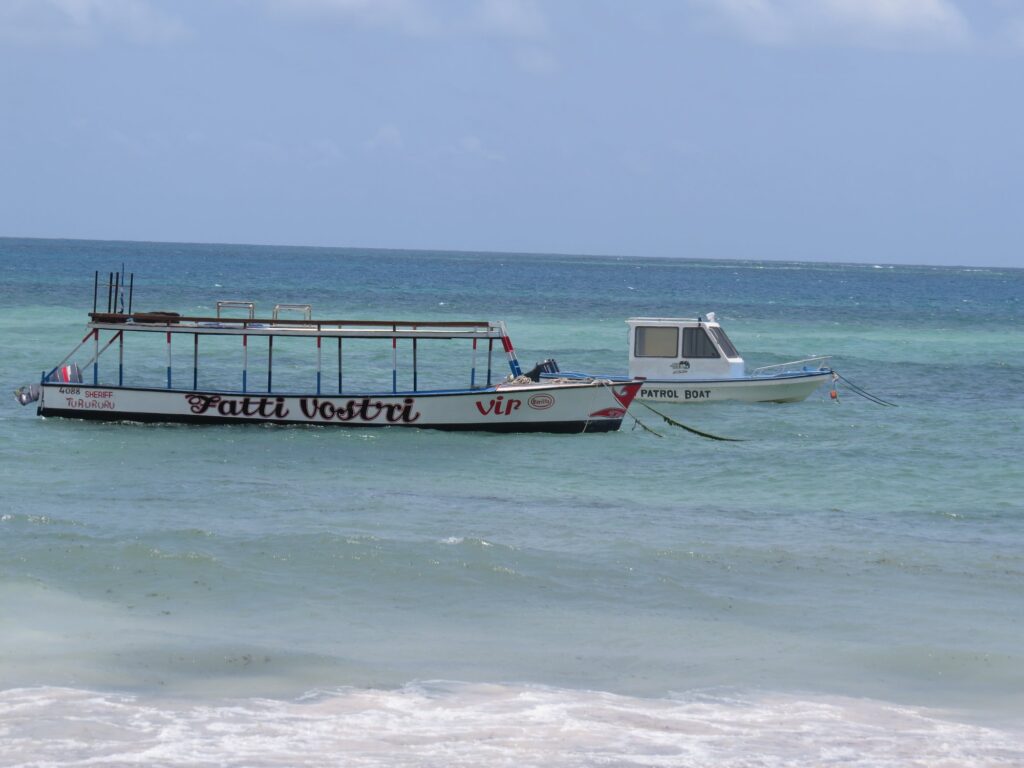
The reserve extends 3.5 nautical miles seaward and is managed by the Kenya Wildlife Service (KWS). We speak to a lifeguard that is certified by the KWS, as are several boat operators working here, providing everything from glass bottom boat rides, diving and snorkeling excursions to deep sea and fishing excursions further seaward. Fishing is prohibited within the boundaries of the national reserve. The authorized operators have a good safety record, and they are held to a set industry standard for service delivery.
Depending on one’s adventurousness, they can opt for a simple stroll on the beach, the gentle waves coming up to their calves, or jump in a boat and head off seaward for adventures such as snorkelling, scuba diving to a waiting kaleidoscope of aquatic life. There is a permeating silence out at sea, amplifying the views of water sweeping into the horizon, all around. It is an enthralling sight. There is the occasional sound of dolphins, and birds flying above. It is a 10-minute ride to the marine reserve.
Malindi’s waters offer some of the world’s finest fishing, making it a leading destination to catch the coveted fantasy slam – 5 billfish species in a day. Over 300 species of fish have been recorded, including: sailfish, broadbill swordfish and black marlin all season, blues and stripeys in February /March trevally, angelfish, barracuda, butterfly fish, goatfish, sharks, snappers, surgeon fish amongst others.
Various beach resorts and Malindi town-based angling clubs offer a variety of fishing expeditions including reef and bottom fishing and avail requisite equipment and training for a fee. They also organize periodic fishing tournaments during the high season months, with categories for pros and amateurs, everyone is invited.
As you spend time on the beach, the amazing scenery captivates you. The seaward horizon is dotted with colorful kites, and one can barely make out the figures windsurfing in the distance. In the early afternoon, a gentle breeze begins to pick up. The surfers will increase as the afternoon wears on. This is one of the most pursued watersports here; idyllic due to the regular Northeast monsoon winds in the months of November/December to March; and the cooler Southeastern monsoon winds in the months of March to April. For speed lovers, water skiing is the obvious choice.
The park is enveloped by a national reserve and a 100 ft strip of coastal land.
Taking in the beauty all around us, I understand how the ocean has inspired so much of the morsels of wisdom that this coastal culture has gifted the world. Like many others, my Kenya coast visits gifted me more than I came seeking – connecting with the amazing people and culture and being drawn in by the wonder of the sea. For one, we had literally lived out the saying ‘Bahari haivukwi kwa kuogelea’ which literally means ‘you cannot swim the length of the ocean’. But even more profound is its figurative meaning and application.

Leave a Reply